“Oysters in the pocket
We’re saving for lunch
They say that you waste away
But we’re having more fun, oh
Oh well, that’s miles away
Oh well, that’s miles away
Oh well, that’s miles away
Oh well, that’s miles away”
Christopher Collins / Otis Pavlovic / Royel Maddell
Back in the heady days of 2012 I signed up for a 10 week online writing class hosted by Chris Brogan that changed my life.
Like lots of things it wasn’t the course itself, but rather the people that I met on it that was magic. The classes were conducted through email and a closed Facebook group, and it was in the FB group that we all got to know each other. There were 16 or so Americans, two Brits, and me. We helped each other with the writing exercise, drove Chris to despair, and swapped links to songs we liked , and some songs that no one liked.
Something magic happened.
I can never put my finger on it, but it was different to any online group I’d been in before or since.
Stan may have been the pixie dust. His music choices implied that he certainly consumed pixie dust, but I think, in fairness, that he was our gang leader.
He sent me grits when I mentioned that I’d never had them. I wish I could still say that. We still message each other.
Jackie sent me a painting of a swan which still hangs in my office.
Beverly was our mother figure and I named Mrs Claus after her in ‘The Christmas Kakapo’.
I dedicated that book to Lisa, who encouraged my writing like no other.
Desiree donated generously , and surprisingly to every charity run I ever did, and had dinner with us in Monaghan.
Gwen, the good witch, sent me a brochure, just to see if addressing it to ‘Paul Bond, Monaghan, Ireland’ would get it to me. It did. I keep up with her still.
Renee still keeps an eye on me.
Leanne , well Leanne is God’s gift to me.
Patricia is the original , and still the best witch I’ll ever know.
Barbara still inspires me to do the right thing.
Carol involved me in the I Run 4 club and the impact of that still ripples through my life.
Chris’ parents Diane and Stephen acted like the cheeky kids at the back of the class.
Chris #2 smoked the biggest cigars, and Chris#3 wore the loudest shirts.
John Baloney I’ve met in London, Monaghan and New York, and I love him to bits.
And Josh…
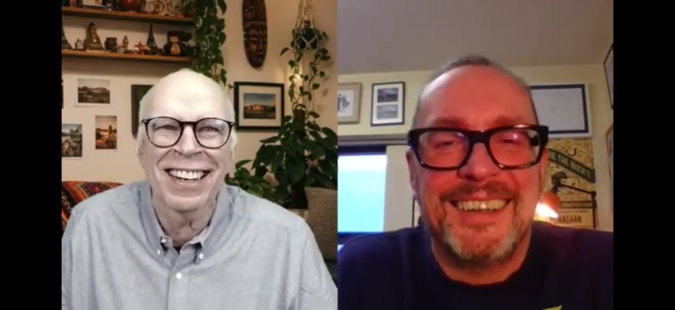
Well Josh and I would message every so often, and this week he invited me onto his podcast, The Long Strange Trip , where we discussed our cancer journeys, while laughing a lot. You can watch on YouTube, or read here.
The magic is still fizzing…
******
Josh : Hey , how are you today, this is Josh Patrick, and you’re at the Long Strange Trip podcast, and my guest today is Paul Bond. Paul and I have had a similar experience, and one I hope that you never have to experience yourself. Both Paul and I are cancer survivors of going through very serious cancer treatment while trying to run a company…at least for me it was trying to run a company, Paul may have been doing it better than I , but we’ll find out. So we’re going to start there and we’ll bring Paul on and start the conversation. Hey Paul how are you today ?
Paul :Josh, I am fine and dandy, thank you for asking.
J: I love that ! Fine and dandy. By the way , Paul is very funny and is one of the most prolific and interesting writers you are going to ever come across if you want to read fantasy. He writes fantasy incredibly well, but we’re not going to talk about that right now.
P:No.
J:So Paul , you had a very serious cancer event a couple of years ago and you are the CEO of your company which means that you probably have areas of responsibility that you tried to take advantage of while going through your cancer treatment, so can you talk a little about both what your treatment was, what you had to do to try and keep the company afloat while you were going through cancer treatment ?
P: Well three and a half years ago now they discovered that I had what proved to be a tumour in my bladder and it was initially diagnosed as being relatively minor, straight forward operation, should be able to sort it out. And then after that operation it proved to have been more advanced than they initially thought and that led to a referral to a second consultant and ultimately necessitated 16 weeks of chemotherapy and then a further operation which resulted in the removal of my bladder, prostate, left kidney and various lymph nodes that were in the way. It had me out of action really from the very beginning of the 16 week chemotherapy and I’m very fortunate in that we have a family company , which I ran with my two brothers, so, for me it was a very straightforward thing to delegate everything, and they insisted on me just focusing completely on what I was going through and recovery out the other side. So I effectively absolved myself of all responsibilities, and its one of those very, very humbling things that in my eight-month absence the company did much, much better than it had done at any point in the previous ten years.
J: Funny how that happens.
P:Yes. It turned out that I was dispensable. I was probably out for eight months completely and then ever since I sort of come and go. There are areas of the business that I have to focus on at times , like contracts that come up and I may be quite busy at those for a while , but they are quite happy for me to potter about in between those times. I’ve gotten involved in a project where we build large wooden sculptures , Drumlin Giants in Rossmore, our local Park. I potter about doing that. And for the last three years I have had CT scans and various tests every six months and just last June they spaced those out to 12 months as everything seemed to be holding its own.
J: That’s great news. I know that after my cancer treatment, every time we had a screening, and I was waiting for the doctor to come into the room I was always panicked because for some reason I was expecting bad news, not good news.
P: I think that’s a perfectly natural thing. In between when I get called for the CT scans which is typically four weeks before my meeting with the consultant , my wife notices at that time I’m not the easiest person to live with , I don’t sleep, .Exactly what you said, a test has been done , somebody has the results, they’re sitting somewhere in a drawer, and until that person in a white coat walks into an office just at that split second its Schrodinger’s cancer, I have it back , or I don’t , until they smile or look serious.
J:Yes you can wait 18 years to have it come back again. Which , I actually guess is pretty fortunate if you really want to think about that because I assume your cancer had a relatively low survival rate, as mine did ?
P: It seemed to be quite aggressive. It’s not very often that I’m in the younger age bracket of anything anymore, but it seemed that I was at the younger end of getting that particular type of cancer because its normally associated with people who smoke , which while I did smoke when I was younger, I hadn’t smoked in 25 years, so that wasn’t a factor. And then subsequent to my operations they discovered a second , unrelated cancer in my prostate. So, like yourself, I was in that narrow band of people who had two active different types of cancer at the same time, so I do consider myself very fortunate. But they did tell me that the nature of the original cancer that I had is that it will come back at some stage so that ‘s why they keep me under surveillance , and that hopefully they’ll spot it early enough..
J: Yes, hopefully if it comes back they have something they can do about it.
P: Exactly .And I have other organs that I’m prepared to sacrifice.
J: Ha ! And what might that be ?
P: I’d rather not put them in order right now…hopefully something that I have two of, and they can take one.
J: That would be a good thing. So, smokers get bladder cancer , that’s something I did not know.
P: Well , they’re more prone to it. Apparently, they said, in 90% of the cases they come across it’s someone who is smoking.
J: Interesting. As regards your treatment and diagnosis, and all that kind of good stuff, you seem to be a pretty positive guy, were you able to stay positive through all of that ?
P: I was. Our health service, much like probably everybody’s health service , is constantly derided in the media but once I was involved in it I just marvelled at the care and attention that I was getting . Obviously we’re very fortunate over here in Ireland that we have a public health system, so even though I had private health insurance, the second operation was at a level that couldn’t be facilitated in any private hospital. My whole chemo and second operations and follow ups have all been on the public health system and I just marvelled at the care and attention I got, how prompt it was. The only time I got down was after the first operation, which , in advance they had thought would sort everything out and the being told it didn’t. That was during the height of Covid so my wife couldn’t come into the consultants room with me to get the results and she was sitting out in the car…he told me this is a lot bigger than we thought and it will necessitate the removal of the bladder and possibly the left kidney, so that was a shock but the worst thing then was walking back out into the car park and having to say that out loud to my wife and ….yeah, that was the lowest point throughout everything. After that we’d go up to Dublin every Wednesday for my chemo treatment and one day I counted , going into the hospital that day from the receptionist greeting me to the nurse coming to take my bloods, a lady coming around with tea and Madeira cake, I think I counted 26 people that on that Day Ward,that I interacted with that day, and they all said my name .And it was a Day Ward , so they were seeing upwards of 100 people that day and every other day, and when I’d go back the second week they’d ask ‘Is Eileen with you today ?’ ‘ Is she out in the car’ they’d remember my kids names and I couldn’t believe it….They were seeing hundreds of people and I was being dealt with by 5 or 6 chemo nurses and couldn’t even remember their names from one week to the next.
J: That seems typical for me also , but your care seems to be a much higher level than what I got. My oncologist was great, and the nurses were good but nobody, you know, I wasn’t greeted by name by everybody I ran across. So that’s incredible and probably made it easier.
P: Certainly did.
J: So how did your family handle all this stuff ?
P:My mother had been diagnosed with Non-Hodgkins Lymphoma, gosh, nearly 35 years ago , so with my parents and my two brothers we had some familiarity with someone who had cancer but it was still a shock to everybody but I’d generally be a positive person , so I think me being positive about it probably kept them going. And then in my own family , my wife looked after everything , and she’d be quite a positive person too, and we have three of our own kids who are now all in their early 20s and I would imagine it was toughest on them because this was something that just wasn’t supposed to happen and, yeah , probably affected them more than others.
J:So, did you go public with your cancer , or did you keep that private ?
P: Oh no, I told everybody.
J: I actually think that’s the right thing to do. Did you find that the more people you told , the more support you got ?
P: Oh absolutely. People were very, very supportive and, I know you know, but I write a weekly blog, every Friday, so from the earliest treatment I used a photo of myself in a gown getting an infusion of something and then posted about it week by week. And it led to people that I didn’t know very well calling to my house, baking cakes for me. Do you remember an old friend of ours Carol Dublin, from that writing thing years ago , well she had a Facebook group, I Run 4, where they matched runners with ill children and you posted photos of your run that day , dedicated it to them, and wrote that you’d been thinking about them. It was just some sort of interaction that somebody far away was interested in them. But that was years ago, and a young chap , Jarrett, that I’d been paired with, who’s a young man now, I’d stayed in touch with him and his mother, and about three or four weeks into my chemo treatment I received a care package from them in America, with warm socks and ginger lollipops and , so, yes, letting everyone know allowed them to be nice about it, so , yeah, it was very much a positive thing.
J: How about your customers, did they have any reaction ?
P:Yes, they did. Lots of them reached out and probably didn’t hassle my brothers too much for discounts during that time….yes, as I said, everyone …they really couldn’t have been more helpful and supportive.
J: Yeah, I found when I was going through my treatment , my major treatment, that my customers were very…what’s the word I’m trying to think of … they were very accepting of what I was going through , and they only called if they had an important reason to talk to me. Otherwise they pretty much left me alone for two years. And that was a really good thing, because , unlike you , I didn’t have brothers who could step in and take over the business. It was sort of me , myself and I… So what kind of advice would you have for anybody that’s about to , or gets diagnosed with a life threatening cancer diagnosis ?
P: When I was going through my treatment I embraced it , I don’t know if that makes sense ? I had an oncologist, a urologist consultant and all of these wonderful nurses and they had training and I did not, so I didn’t look up anything. Just don’t Google anything, do what your nurses and doctors tell you would be my advice . And keep a diary, tell everybody, write down how you’re feeling about different things, and don’t be afraid to tell everyone what you’re going through. You’ll be surprised at the support you get, and sometimes, where you get it from. I had fellas that I’d been at school with and hadn’t seen in maybe 30 years reach out to me. And it’s a very, very odd thing to say, and obviously its life changing , but my brother Stephen said to me, I think it was only last year “Paul, don’t take this the wrong way, but you having that cancer has been the making of you.”
J: I was told that by a couple of people. That you’re a bit softer.
P:You certainly have a different perspective, different things are important to you , that and your focus definitely changes dramatically. Up until something like that happens you think that you’re going to live forever and then you realise that you’re not…unless it’s going to be a head in a jar somewhere , which I don’t fancy. My wife said to someone at some point when they asked ‘How’s Paul getting on with his treatment ?’ , and she said “If he was any more enthusiastic about it he’d be recommending it to people !”
J: Somehow I’m not surprised by that. My goal going through cancer treatment was just to stay in the present. Just show up, put one foot in front of the other, and whatever the day brought, the day brought. No catastrophising, or saying life’s going to get great in x amount of time. It’s interesting , in Viktor Frankl’s book ‘ Man’s Search For Meaning’ he talks about the people in the concentration camps who survived and they were people who didn’t think about what the future was going to bring , would they be out by Rosh Hashanah, or by Passover. If you just stayed neutral you had a better chance of surviving than if you either catastrophised, or think things are going to be great. And I think that’s pretty much true for cancer treatment too .
P: It definitely is. Everyone, as I said, was very supportive , but some people, almost despite themselves were almost commiserating with you , saying ‘Oh this is terrible , you must feel awful’, or ‘How will you ever manage to get through this’. So you quickly learn to avoid people like that. I know they mean well but, they were nearly hoping for more bad news.
J: I don’t know if they were really hoping for more bad news I think what it is , is that they were talking about themselves more than you.
P: True. I would say to some of those people, or anyone that would say something like that , that in my whole cancer treatment journey probably the time I was in greatest danger was when I was driving to Dublin from Monaghan and the journey home in the car. Everybody leaves their house everyday and they don’t really know what’s going to happen. It is definitely a positive thing through an illness, or treatment like we’ve had that you can prepare too. It makes you think about what way you want things to be left, not to the nitty gritty of who’s going to get that vinyl album, or that piece of signed memorabilia, just in general , that I do want to speak to this person or that person , or I want them to know how I feel about them, and not leaving any of those things until I might meet them from now on.
J: And when you read about people at the last stages of life that’s one of the main things that people are sorry that they didn’t do more of , which is tell people how they felt about them. I’m about to write a Substack article basically saying that we all need more hugs. I don’t think we have enough hugs in life. I think that the people who find giving hugs off putting should re-examine that. Its one of those things where physical contact is important.
P: I’m an active hugger myself.
J: I would invite anyone who comes across me and wants to give me a big hug to go right ahead and do so.
P: Two of my best friends, Micky and Ronan, we were all at school together, and we’d always try to meet up once a year, but as we’d all got married , and Micky lives in Dublin, Ronan lives in London, and we’ve families and what not, we sometimes let it slip. So when I was ill they were both very keen that as soon I was out of hospital and felt up to it that we’d arrange to meet up for dinner. So we’d arranged a date and then Ronan asked if another friend Milo would come, and then would Cyril join us, and we ended up with 10 of us that night. And some of us hadn’t been together , as that group, since 1984 when we left school. We called it the ‘Not Dead Yet Dinner’ and we’ve had it annually for the last three years and there were 20 of us there last November. It’s great, guys that shared a formative time together, and, my illness led to that …and other things like that. I made this pledge, well it wasn’t a stupid idea, but I decided that I wasn’t going to say no to anything. The stupid part was writing it in my blog so other people were aware of it , now if they ask me to anything they know I cant say no. I go to different concerts and festivals and if anyone wants to go for dinner , or a pint , I don’t say no anymore I just say ‘Yeah, lets go’. It’s a good attitude.
J: It is a good attitude. So Paul, unfortunately we’re out of time , so if someone wanted to talk to you in their own cancer experience, would you be willing to do so.
P:Absolutely.
J: So if they wanted to contact you , how would they go about that ?
P:My blog has it’s own website, SuperJetRobotDinosaurs.com , they are welcome to contact me through that.
Sounds good.
**********
And that was that.
You never know who you meet for a moment, or never meet at all in real life, but will ripple through your life with you.
It can be wonderful.
( Don’t eat grits !)
Toodles,
Paul
P.S This is for you ‘Oysters In My Pocket’.
P.P.S If you aren’t tired of my voice already, I’ve started season 2 of my Substack, definitely not a podcast, which you can listen to here.
